
The Origins of Skweek on the Amstrad Platform
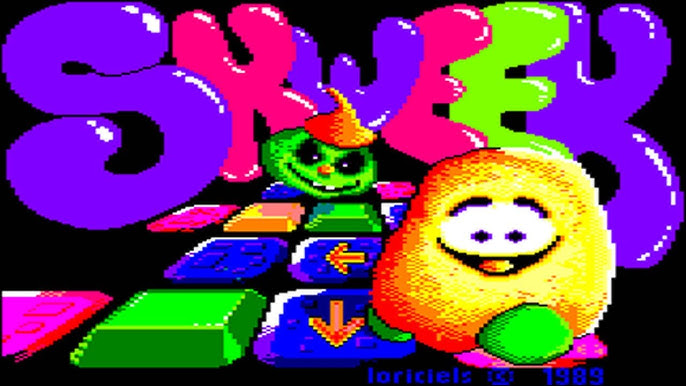
Skweek emerged during the late 1980s, a period widely regarded as the golden age of 8-bit home computing. The Amstrad CPC had already secured a strong foothold in European households, particularly in the United Kingdom, France, and Spain. Developers were experimenting boldly with color palettes, arcade mechanics, and puzzle concepts. In this creative climate, Skweek was born as a distinctive blend of action and strategy that immediately separated itself from the crowd.
Unlike many titles that focused purely on shooting or platform jumping, Skweek centered its gameplay around transforming tiles while navigating increasingly complex arenas. The concept was simple at first glance, yet brilliantly layered. The player controlled a small, bouncing pink creature tasked with repainting blue tiles across the board. Beneath that simplicity, however, lay a surprisingly demanding system of timing, enemy avoidance, and spatial awareness that required genuine mastery.
The Amstrad CPC’s graphical capabilities played a significant role in Skweek’s appeal. The machine was known for vibrant colors, particularly in its lower-resolution modes, and Skweek embraced this fully. The bright pastel design was more than aesthetic charm; it created a readable, high-contrast playing field that enhanced clarity during fast-paced action. This careful balance between visual flair and mechanical precision marked Skweek as one of the standout puzzle-action titles on the platform.
Gameplay Mechanics and Core Design Philosophy
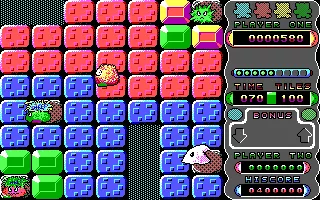
At its heart, Skweek is a tile-conversion puzzle game. The objective is straightforward: bounce across all blue tiles and convert them to pink before enemies catch you. Once every tile is transformed, the level is complete. While that premise may sound repetitive, the genius of the game lies in how each new stage introduces fresh obstacles, layouts, and hazards that force players to adapt constantly.
Movement in Skweek is fluid and slightly slippery, adding a layer of challenge that prevents the experience from becoming trivial. The character does not stop instantly; instead, momentum must be managed carefully. This small detail transforms each level into a test of controlled chaos. Players must anticipate enemy paths while calculating the most efficient route to cover every tile without cornering themselves.
Enemies add another dynamic element to the experience. They patrol the board with predictable but increasingly aggressive patterns. Some move randomly, while others track the player more directly. This gradual escalation ensures that the game never feels unfair, yet it steadily raises the tension. Each board becomes a miniature strategic puzzle that rewards planning as much as reflexes.
Visual Style and Audio Presentation
One of Skweek’s most memorable attributes is its bright, almost candy-like visual identity. The pastel tiles, cheerful character design, and crisp geometric layouts created an inviting atmosphere that contrasted sharply with darker arcade games of the time. On the Amstrad CPC, color was a strength, and Skweek leveraged it to maximum effect.
The animation of the main character was smooth and expressive within the hardware’s limitations. The bouncing movement gave Skweek personality, making it more than just a functional sprite. This sense of character contributed greatly to the game’s charm and long-lasting appeal among retro gamers.
The sound design complemented the visuals effectively. Short, catchy musical loops and clear sound effects enhanced gameplay feedback without becoming overwhelming. Each tile conversion produced satisfying audio cues, reinforcing progress and maintaining player engagement. While the Amstrad was not renowned for advanced audio capabilities compared to some competitors, Skweek demonstrated how clever composition could overcome technical constraints.
Level Design and Difficulty Progression
Skweek’s level design is a masterclass in gradual complexity. Early stages function as tutorials, teaching the fundamentals of movement and tile conversion. As players advance, layouts become more intricate, featuring narrow corridors, isolated platforms, and strategic choke points that demand careful navigation.
Difficulty increases not merely through faster enemies but through clever structural design. Certain levels require players to think about order of operations, deciding which areas to clear first to avoid trapping themselves. This progression ensures that the challenge feels earned rather than artificially inflated.
Later levels introduce additional hazards and more sophisticated enemy behaviors. The game’s pacing keeps frustration manageable by maintaining short level durations. Even when players fail, restarting feels quick and fair. This balance between challenge and accessibility is a major reason Skweek remains fondly remembered decades later.
Technical Performance on the Amstrad CPC
From a technical perspective, Skweek ran impressively well on the Amstrad CPC hardware. The system’s Z80 processor, combined with its versatile graphics modes, allowed for smooth animation and responsive controls. Despite the hardware’s limitations, the game avoided noticeable slowdown in most scenarios.
Memory constraints were handled efficiently. Levels loaded quickly, and the compact design allowed for a substantial number of stages without excessive disk swapping. This technical optimization reflects careful programming and an understanding of the Amstrad’s architecture.
The game also showcased intelligent use of screen resolution and color palettes. By prioritizing readability and simplicity in tile design, developers ensured that gameplay clarity remained intact even during chaotic moments. This technical foresight significantly enhanced playability.
Strategic Depth and Player Skill Development
Although Skweek may appear simple, long-term success requires strategic refinement. Players gradually learn optimal movement patterns, enemy avoidance techniques, and route planning strategies. The game subtly encourages efficiency by rewarding smoother, more deliberate runs.
Over time, players begin to anticipate enemy cycles and develop muscle memory for common tile arrangements. This progression from reactive play to proactive strategy is deeply satisfying. The sense of mastery that develops after repeated attempts creates a compelling feedback loop.
Furthermore, Skweek encourages risk assessment. Sometimes it is safer to clear outer edges first; other times, central control prevents enemy congestion. These micro-decisions create variety across levels, preventing monotony and keeping the gameplay mentally stimulating.
Cultural Impact and European Gaming Scene
Skweek’s popularity was particularly strong in Europe, where the Amstrad CPC had a substantial market presence. The game became emblematic of the creativity emerging from European studios during the late 1980s. It demonstrated that compelling design did not require massive budgets or complex narratives.
In France and the United Kingdom especially, Skweek gained recognition as a standout puzzle-action hybrid. Its approachable design made it accessible to younger players, while its escalating difficulty appealed to more experienced gamers. This broad demographic reach strengthened its cultural footprint.
The game also contributed to the reputation of European developers as innovators in the puzzle genre. It stood alongside other inventive titles of the era, reinforcing the idea that creativity thrived in smaller studios willing to experiment with unconventional mechanics.
Comparison with Contemporary Titles
During its release period, many games on 8-bit systems emphasized shooting mechanics or platforming challenges. Skweek diverged from this trend by focusing on territory control and spatial planning. This differentiation made it refreshing in a crowded market.
While some contemporary puzzle games leaned heavily on static, turn-based gameplay, Skweek introduced real-time pressure. The constant movement of enemies ensured that players could never remain idle. This blend of puzzle thinking and arcade urgency gave it a distinctive identity.
Compared to other Amstrad titles, Skweek maintained a polished balance of aesthetics and mechanics. It did not rely on flashy gimmicks but instead delivered consistent, refined gameplay. This reliability contributed to its enduring legacy among retro enthusiasts.
Replay Value and Longevity
One of Skweek’s strongest attributes is its replay value. Because levels are short yet challenging, players often return to improve performance or conquer previously difficult stages. The addictive cycle of failure and improvement keeps engagement high.
The increasing complexity ensures that later levels feel like genuine accomplishments. Completion requires dedication and practice, which enhances satisfaction. Even decades later, players revisit Skweek for its nostalgic charm and surprisingly robust challenge.
Additionally, the simplicity of the core mechanic ensures timeless accessibility. Modern players accustomed to complex interfaces can quickly grasp Skweek’s rules, making it an easy recommendation for retro gaming exploration.
Legacy and Modern Appreciation
Today, Skweek is remembered as a classic example of clever 8-bit design. Retro gaming communities frequently highlight it as one of the Amstrad CPC’s standout titles. Emulation and preservation efforts have ensured that new generations can experience it.
Its enduring appeal lies not in advanced graphics or cinematic storytelling but in precise mechanics and thoughtful design. Skweek exemplifies how limitations can inspire creativity. By focusing on strong fundamentals, the developers crafted an experience that transcends technological eras.
The game’s cheerful aesthetic, balanced challenge, and strategic depth continue to resonate. In many ways, Skweek represents the spirit of 8-bit innovation: compact, colorful, and cleverly constructed.
Final Thoughts on Skweek Game Amstrad
Skweek remains a shining example of how a simple idea can evolve into a deeply engaging experience. Its tile-conversion gameplay, vibrant presentation, and carefully structured difficulty progression make it more than just a nostalgic relic. It stands as a testament to the creativity of late-1980s European game development.
For enthusiasts of retro computing, Skweek offers a perfect blend of accessibility and challenge. It demonstrates how effective design principles can endure far beyond their original hardware constraints. Even in an era dominated by high-definition graphics and expansive open worlds, Skweek proves that thoughtful mechanics and personality remain timeless.
Ultimately, Skweek on the Amstrad CPC is not just a game; it is a celebration of 8-bit ingenuity. Its lasting reputation is well deserved, and its influence on puzzle-action design continues to be appreciated by those who value smart, focused gameplay.
FAQs
What is Skweek on the Amstrad CPC?
Skweek is a puzzle-action game where players convert blue tiles to pink while avoiding enemies.
When was Skweek released?
It was released in the late 1980s during the peak of 8-bit home computing.
What makes Skweek unique compared to other 8-bit games?
Its blend of real-time arcade action with tile-based puzzle strategy sets it apart.
Is Skweek considered difficult?
Yes, it starts simple but becomes increasingly challenging as levels progress.
Can modern players still play Skweek today?
Yes, it can be experienced through retro hardware or software emulation.